
Why Does the Breaker Trip When the AC Turns On?
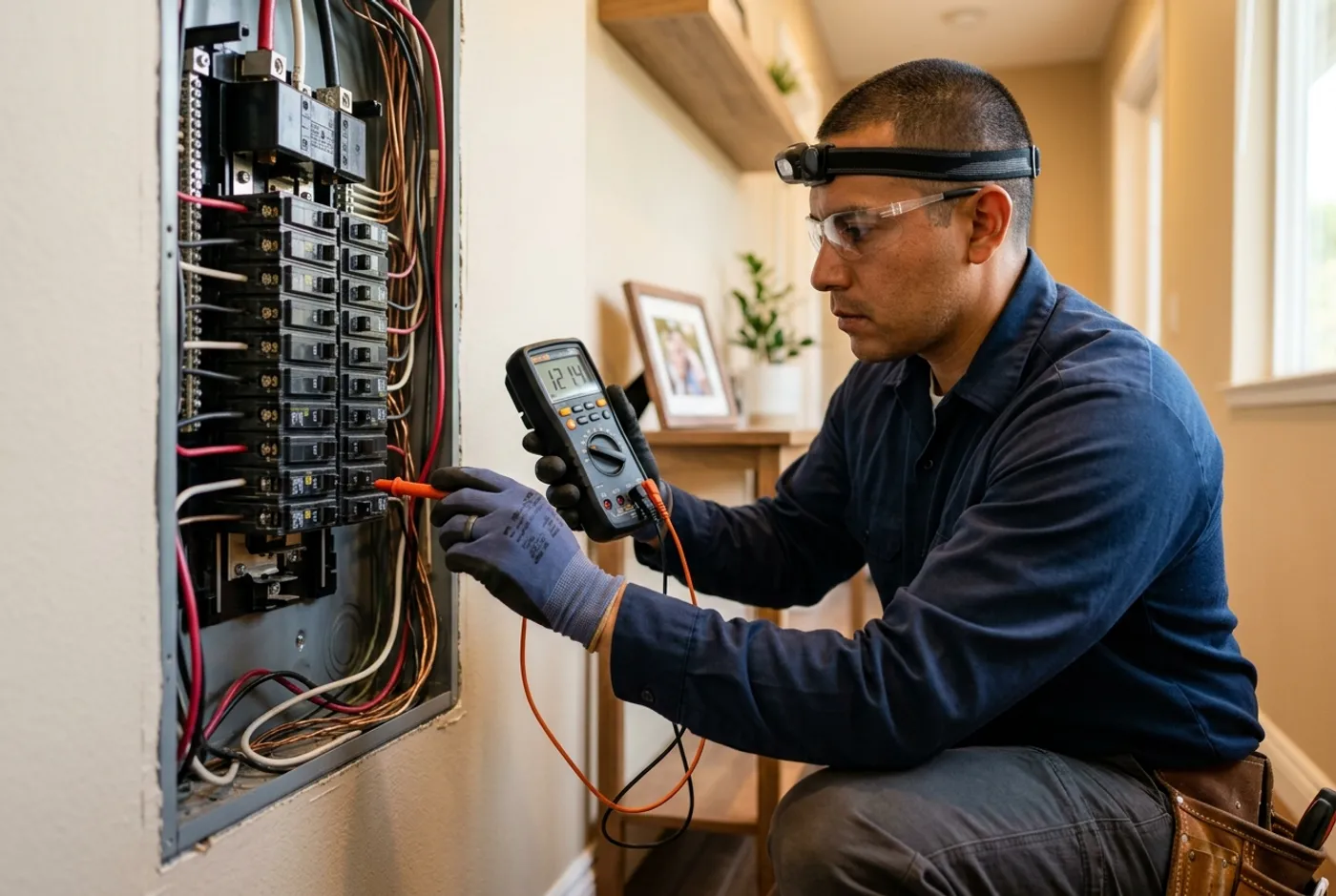
A breaker that trips the instant your AC starts almost always means a part inside the AC has worn down. It does not mean the breaker itself is broken. Starting an AC compressor pulls six to eight times its normal running power for about one second. That strong pull is supposed to happen. A weak capacitor, a worn contactor, or a dirty coil can be the difference that tips a healthy breaker over the edge. In Victor Valley homes built in the 1970s and 80s, four months of 90-plus-degree summer days push that worn part toward failure. Get a free estimate from Rufino Electric before you reset that breaker one more time.
Why does the breaker trip the instant the AC turns on?
Every time your AC's compressor turns on, it pulls a hard jolt of power. This lasts about one second, before the motor is up to full speed. Electricians call this inrush current, or locked rotor current. The motor has not started spinning yet, so it cannot push back against the power coming in. That is why it draws far more power than it will once it is running. A healthy compressor can pull six to eight times its normal running power during that one-second jolt. This comes from standard motor engineering references.
The national electrical code already expects this. NEC Article 440 is the code section that covers air conditioning equipment. It sets the breaker size straight off the compressor's own nameplate rating. The breaker is built well above the compressor's normal running power on purpose. It needs that extra room for the one-second jolt. So when a breaker trips the moment the AC starts, the breaker is not too sensitive. Something else has already used up the extra room it was built with.
Why does the trip happen right at startup instead of randomly through the day?
That one-second jolt only happens because the motor has no push-back the instant it starts. Once the motor is spinning, it builds its own resistance and the power draw drops to a normal level. This takes about a second. That is why a breaker that trips at the moment the AC turns on usually points to something wearing out inside the unit. A wiring problem that was always there tends to show up any time the circuit is under load. It would not wait for just one moment to show itself.
What inside the AC wears down enough to cause this?
A few parts commonly take the blame. Rufino Electric checks each one.
A weak or failing capacitor. A capacitor sits on your compressor's motor. Its job is to ease that power jolt at startup. When a capacitor weakens or fails, the motor loses that help. It has to pull harder and longer to get up to speed. A weak capacitor is one of the most common repairs behind a seasonal breaker trip. It is also cheap to fix. It tends to fail on the year's hottest, hardest-working days.
A pitted contactor. A contactor is a switch that turns the compressor on and off. In a High Desert summer, it closes and opens over and over, dozens of times a week. Each time it closes, a small spark can wear and pit the metal contacts. A pitted contactor adds resistance right where the heaviest startup power flows. That extra resistance can be the last straw for a breaker that was already close to its limit.
A dirty condenser coil. Energy Star's own home maintenance guidance says dirty coils make a cooling system work harder. The system runs longer, costs more to run, and wears out faster. A dirty coil blocks airflow. That forces the compressor to push harder to move the same heat. Its running power stays higher on every single cycle, not just at startup. A coil cleaning is often the real, inexpensive fix behind what looks like a breaker problem.
If a visit from our electrical repairs and troubleshooting service traces the fault to the AC itself, not the house wiring, we will tell you plainly. Then we point you to your AC technician for that part of the fix.
Why do AC-triggered trips cluster in older Victor Valley homes?
The High Desert around Adelanto and Victorville averages 118.8 days a year at 90 degrees or hotter. The Hesperia side of the valley still logs 107.7 days a year that hot. Both numbers come from NOAA's 1991 to 2020 climate normals. Nearly four months of 90-plus days means the compressor cycles on and off under heavy load all summer. Every single cycle pulls that hard power jolt. A marginal breaker, a worn capacitor, or a pitted contactor only has to fail once at the wrong moment. In the Victor Valley, that moment comes dozens of times a week for four straight months.
That load lands hardest on the valley's older homes. About 51% of Apple Valley's homes and 46% of Hesperia's homes were built in the 1970s and 80s. Their median years built are 1987 and 1988. These numbers come from the Census Bureau's 2019 to 2023 American Community Survey. Panels from that era were built with 100-amp service, sized for a much lighter load than today's homes carry. A 100-amp panel has far less spare room than a modern 150 to 200-amp service. When a hot afternoon pushes an aging compressor into a hard start, the worn breaker behind it has very little room left to absorb that jolt. That is the real, local reason AC-triggered trips cluster in this housing stock. It is not a random appliance fault. If your panel is part of that story, upgrading an aging 100-amp panel restores the room a modern AC needs. Our post on the other signs your panel is past its limit walks through the rest of the warning signs.
Does a central air conditioner need its own dedicated circuit?
Yes. NEC Article 440 requires a central AC to run on its own dedicated circuit. It also requires a disconnect switch within sight of the outdoor condenser unit. A dedicated circuit means the AC does not share a breaker with anything else in the house. A fridge or a hair dryer turning on elsewhere never adds to the AC's own startup draw. If you are not sure whether your AC has its own circuit, that is worth checking before the next heat wave. For general summer electrical safety steps beyond the AC circuit itself, see our seasonal guide.
Frequently asked questions
Is it safe to keep resetting the breaker if the AC keeps tripping it? No. A breaker trips to protect your wiring from too much power. Resetting it over and over just lets that strain keep happening. Each reset can wear a failing part down further. In rare cases it can even heat up the wiring. Call a licensed electrician and get the real cause checked first.
Can a dirty air filter cause the AC to trip the breaker? A dirty filter does not trip a breaker by itself. But it can feed the same problem. Energy Star's own maintenance guidance says dirty coils make the system work harder and run longer. A clogged filter blocks airflow the same way a dirty coil does. That can push a struggling compressor closer to the edge. Rufino Electric checks the whole system, not just one part.
Why does the AC breaker trip after running a few minutes instead of right at startup? A trip right at startup usually points to the first-second power jolt every AC pulls when it turns on. A trip a few minutes in points somewhere else. It means the compressor's running power is staying too high instead of settling down. A dirty coil or a weak capacitor can both cause that. Rufino Electric tests for both patterns, not just one.
Get a free estimate from Rufino Electric
Rufino Electric is a licensed, veteran-owned and family-owned electrical contractor (CSLB #1148482) based in Adelanto. We serve Victorville, Apple Valley, Hesperia, and the wider Victor Valley with 24/7 emergency service. A breaker that will not stop tripping never has to wait until morning. Three generations and 45 years of family electrical experience back every job. We stand behind the work itself with a 1-year labor warranty and a 2-year warranty on parts and equipment. Call (714) 631-4562 or request an estimate online, and we will track down the real cause before we tell you what it costs to fix.
Talk to Rufino Electric
Questions about your electrical job? We serve Adelanto and the surrounding area with honest, upfront advice.
Related articles
FAQ
Related questions
Is it safe to keep resetting the breaker if the AC keeps tripping it?
No. A breaker trips to protect your wiring from too much power. Resetting it over and over just lets that strain keep happening. Each reset can wear a failing part down further. In rare cases it can even heat up the wiring. Call a licensed electrician and get the real cause checked first.
Can a dirty air filter cause the AC to trip the breaker?
A dirty filter does not trip a breaker by itself. But it can feed the same problem. Energy Star's own maintenance guidance says dirty coils make the system work harder and run longer. A clogged filter blocks airflow the same way a dirty coil does. That can push a struggling compressor closer to the edge. Rufino Electric checks the whole system, not just one part.
Why does the AC breaker trip after running a few minutes instead of right at startup?
A trip right at startup usually points to the first-second power jolt every AC pulls when it turns on. A trip a few minutes in points somewhere else. It means the compressor's running power is staying too high instead of settling down. A dirty coil or a weak capacitor can both cause that. Rufino Electric tests for both patterns, not just one.